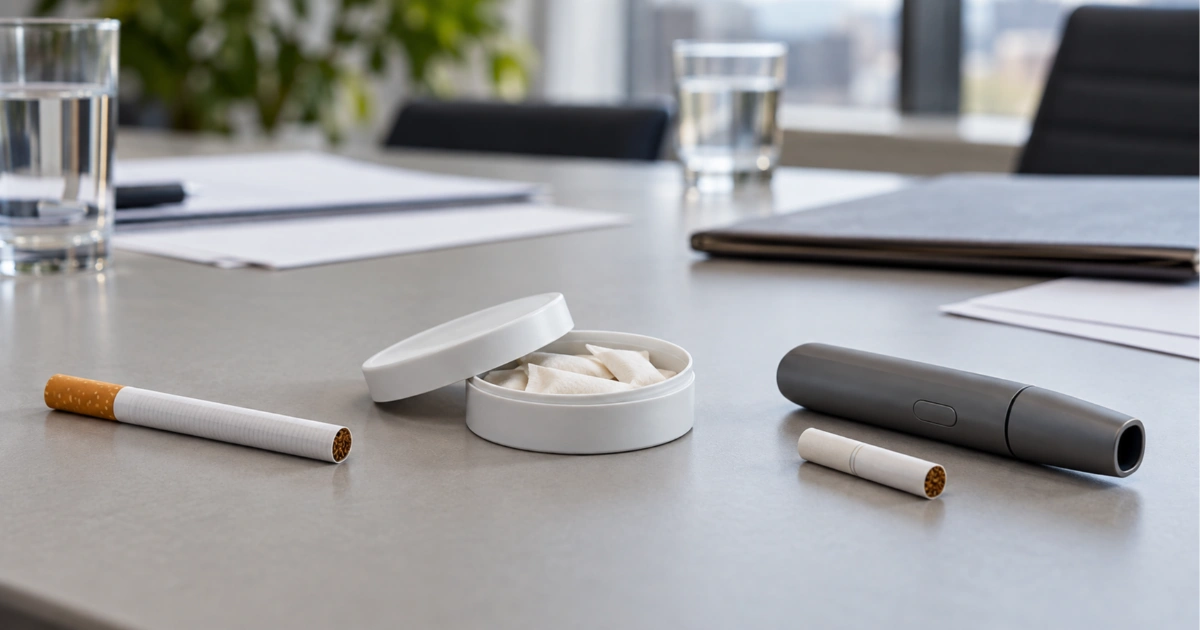
Developments in Canada, research on heated tobacco and New Zealand’s smoking trends are renewing debate about whether nicotine products should be regulated according to their risks relative to cigarettes. The examples point to the importance of combustion and access to alternatives, while leaving questions about long-term health effects and policy outcomes open.
Canada’s restricted market for nicotine pouches
Canada shows how tightly controlled legal access can sit alongside the circulation of unauthorised products. Nicotine pouches are not banned, but the authorised market is limited. Since 2024, approved products with no more than 4 mg of nicotine per dose have been treated as cessation products and sold only through pharmacies. Flavours are effectively limited to mint and menthol, and Zonnic is the only authorised pouch. Ottawa is reportedly open to reconsidering pharmacy-only sales, but no policy change has been confirmed.
Unauthorised pouches continue to circulate through less regulated channels. A seizure at the Blue Water Bridge reportedly involved 2,796 kilograms of pouches valued at almost CAD 3 million. The result is a contrast between limited access and choice for adults seeking authorised products and stronger products available through less controlled channels.
One option raised in the debate is to retain nicotine limits and packaging and marketing restrictions while allowing authorised pouches to be sold through licensed, age-restricted retailers. Supporters argue this could help regulated products compete while maintaining youth protections. The wider point is that nicotine products do not all carry the same risks.
What heated tobacco research has found
At the Global Forum on Nicotine 2026 (GFN26), Dr Leonie Price presented research on heated tobacco products (HTPs), including studies of aerosol chemistry, biomarkers of exposure and consumer behaviour. One laboratory investigation measured 54 harmful and potentially harmful constituents across 12 consumables and several heated tobacco systems. Price said the products examined consistently produced substantially lower emissions than cigarette smoke.
A short randomised trial compared smokers using blade-heated and newer induction-heated devices with people who continued smoking. Among HTP users, biomarkers linked to cigarette-smoke toxicants fell substantially, while nicotine consumption remained relatively stable. The findings illustrate how nicotine intake can be separated, to a considerable degree, from exposure to many substances produced when tobacco burns.
The evidence needs careful interpretation. Some HTP research has been conducted or supported by manufacturers, and reduced exposure does not by itself establish an equivalent reduction in long-term disease risk. The supplied article also cites independent research: a 2025 systematic review and meta-analysis of 18 randomised trials found that smokers who switched completely to HTPs had significantly lower exposure to 12 measured carcinogenic, harmful and potentially harmful constituents than those who continued smoking. Longer independent studies are still needed.
Switching and dual use
Laboratory results are only part of the picture; smokers also need to adopt a product and change their smoking behaviour for reduced emissions to matter. Price presented a two-year study of people who had purchased IQOS in Germany and Italy. Around 60% remained users of smoke-free nicotine products, while dual use declined and complete switching and nicotine cessation increased over time.
Because participants had already bought an HTP, they may have been more motivated than the average smoker, which limits how widely the results can be applied. Still, the findings suggest dual use may not always be permanent. For some smokers, it may be a step towards replacing cigarettes completely. The article notes that eliminating smoking generally brings the greatest reductions in exposure to toxicants from combustion.
New Zealand’s smoking and vaping trends
New Zealand’s figures bring the debate to the population level. Daily adult smoking fell from 16.4% in 2011/12 to 6.8% in 2024/25. The estimated number of daily smokers declined from around 572,000 to 294,000. Over approximately the same period, daily vaping rose from 0.9% when it was first measured in 2015/16 to 11.7% in 2024/25.
The Ministry of Health says the parallel trends do not prove that vaping caused smoking to fall. Taxation, smoke-free policies, cessation programmes and changing attitudes also contributed. The supplied article says New Zealand officially recognises vaping as a less harmful alternative for adults who smoke and as a tool that can help people quit.
Smoking has recently levelled off at around 6.8%. New Zealand’s experience adds population-level context to the laboratory findings, but the figures alone do not establish why smoking declined.
Why relative risk is part of the policy debate
Canada’s pouch rules, HTP research and New Zealand’s trends concern different products and cannot show that every alternative will have the same outcomes. Together, they raise a broader question: should nicotine use and cigarette smoking be treated as interchangeable public-health outcomes?
Nicotine pouches avoid combustion and inhalation; HTPs avoid burning tobacco and, in the cited research, reduce exposure to many cigarette-smoke toxicants. The article also describes vaping as avoiding tobacco combustion and as having evidence as a smoking-cessation tool. None of these products is risk-free. Youth access, dependence, marketing and product quality remain concerns that require controls.
The article argues that rules which overlook differences in risk may have unintended consequences, particularly if cigarettes remain readily available while alternatives are harder to obtain. In this view, tobacco harm reduction should consider whether fewer people continue smoking combustible cigarettes, not only whether nicotine use declines.
Source Acknowledgement
Adapted independently from reporting by Diane Caruana for Vaping Post. The source is credited for the reporting; this acknowledgement does not imply endorsement.
Source: Vaping Post
- Author
- Diane Caruana
- Published
- 01 Oct 2026
- Last verified
- 01 Oct 2026