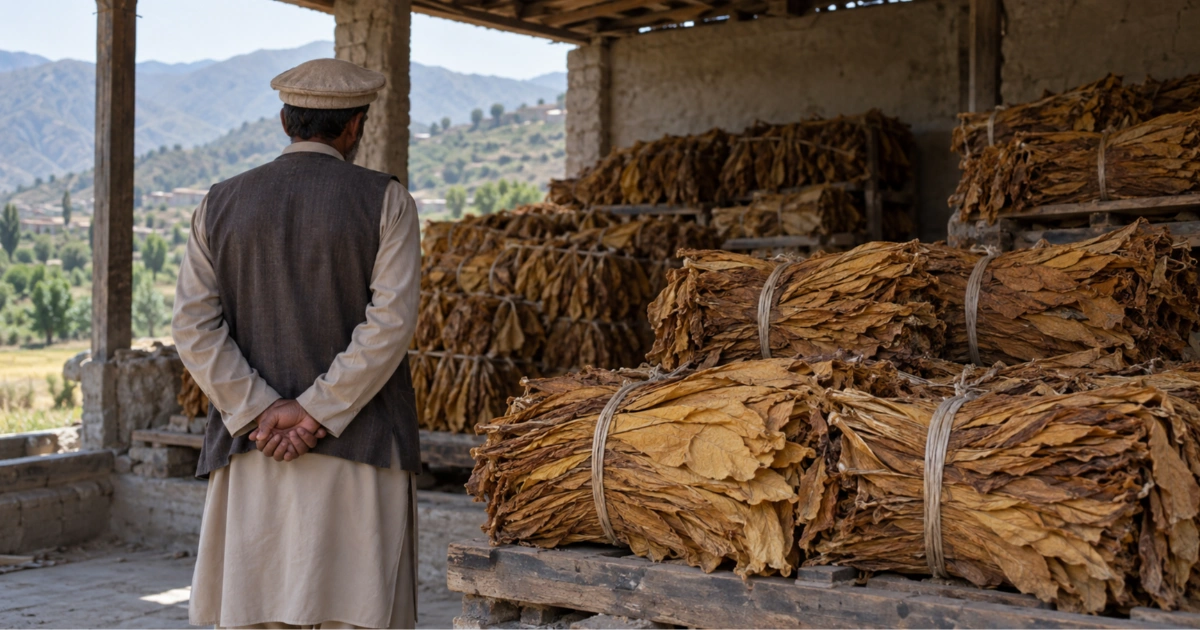
Tobacco growers in Khyber Pakhtunkhwa are burning cured leaf as declared buyer demand falls short of production, according to an article by research economist Wajid Islam. The article argues that weak purchasing commitments, delayed payments and limited competition are leaving farmers with surplus they struggle to sell.
A large crop with too few declared buyers
Islam reports that 45,000 of Pakistan’s nearly 80,000 tobacco farmers are in Khyber Pakhtunkhwa. The province produces 98 per cent of the country’s high-quality flue-cured Virginia tobacco, grown on roughly 26,500 hectares across Swabi, Mardan, Charsadda, Buner and Mansehra. Tobacco accounts for less than 1 per cent of Pakistan’s cropped area, the article says.
The article places the crop’s marketing problems alongside its contribution to federal revenue. Federal excise duty from locally produced cigarettes and tobacco was Rs237.3 billion in FY24, up from Rs66.3 billion in FY17. Islam notes that this is not directly comparable with agricultural income tax, which is a provincial tax on farm income rather than an excise on manufactured products.
Despite the scale of the value chain, growers bear the costs of seedlings, fertiliser, pest control, labour and curing, while taking on the risk that buyers may not take their crop or pay a known price. The article argues that the central issue is not whether farmers should receive subsidies, but whether purchasing commitments can be enforced, prices openly established and payments made on time.
For the 2026 crop, quota allocation was set at 61.63 million kg, the fourth annual reduction in a row. The article compares this with 85.5 million kg for the 2023 crop, followed by 77.3 million and 74.8 million kg. National output has been near 140 million kg, leaving roughly half the crop without a declared buyer before curing begins, according to Islam.
Surplus, prices and delayed payments
The Pakistan Tobacco Board sets a weighted average price for contracted quota and a lower support price for surplus, the article says. Growers are offered between Rs300 and Rs500 per kg for surplus, compared with a production cost they estimate at Rs750 per kg. Islam also reports that some farmers have signed contracts but have not had their leaf collected, while payments for the previous year’s sales remain overdue.
The article says federal excise duty collected by the Federal Board of Revenue from tobacco and cigarette sales fell by 48.3 per cent in FY25, from Rs237.3 billion to Rs121.2 billion. The share of domestic federal excise fell to 19.4 per cent. It places this decline alongside the contraction in declared demand from formal buyers, and warns that growers without storage and with few buyers may sell to whoever offers cash. If the leaf enters illicit cigarette production, Islam writes, farmers are underpaid and the exchequer collects nothing.
Islam says tobacco and tobacco-product exports were roughly $170 million in 2025 across more than 40 markets. He argues that the estimated structural surplus of 50 million to 70 million kg could support an export push, but is instead ending up in stockpiles and bonfires.
Proposals for changing the market
The article points to India’s open electronic auctions for flue-cured Virginia tobacco as an alternative. It says growers there can watch bale-by-bale bidding and receive payment directly into their bank accounts within about nine days. In Pakistan, according to Islam, prices are administered and buyers’ leaf managers grade tobacco at their own depots.
Islam calls for buyers to collect the crop they declared they would purchase and for outstanding payments to growers to be made. He also proposes licensing new buyers, allowing threshing operators and exporters to buy directly from farmers, and introducing auction marketing with grading on a pilot basis in two districts the following year.
Further proposals include making prices for individual bales public, routing payments through the board or an escrow mechanism with a required settlement date, and publishing demand and district-wise contract lists before sowing. The article argues that this would let farmers know earlier whether a buyer has been declared for their crop and allow surplus to be treated as export stock.
Islam’s central argument is that protecting tobacco growers does not require promoting smoking. It requires a leaf market with enforceable contracts, open price discovery and timely payment.
Source Acknowledgement
Adapted from an article by Wajid Islam, research economist at the Pakistan Institute of Development Economics, published in Dawn’s The Business and Finance Weekly on September 28, 2026. The original article was titled “Agriculture: Tobacco — a cash crop without a market.”
Source: Dawn
- Author
- Wajid Islam
- Published
- 28 Sep 2026
- Last verified
- 28 Sep 2026